
ND Miata Trims: Sport vs Club vs Grand Touring
Every US ND MX-5 has the same engine for a given year: the 2.0-liter Skyactiv-G, 155 hp through 2018 and 181 hp from 2019. Trim buys equipment, not power, and most of that equipment is upholstery. Three hardware items actually change how the car drives: the limited-slip differential, the Bilstein dampers with the front shock-tower brace, and the Brembo/BBS/Recaro package. All three are tied to trim, transmission, and model year in ways listings routinely get wrong.
The short answer
Section titled “The short answer”| You want | Buy | Why |
|---|---|---|
| To autocross or track it | Club, manual | LSD, Bilsteins, and the brace standard every year. See autocross classing before adding anything. |
| Leather and the LSD | 2020+ Grand Touring, manual | For 2020 the GT manual got the Club’s LSD, Bilsteins, and brace standard. A 2016–2019 GT manual has none of them (2019 only with the $750 GT-S package). |
| An automatic | Grand Touring | No automatic ND has ever had an LSD, and from 2022 the auto is only sold on GT anyway. |
| The cheapest or lightest ND | Sport, manual | Same engine, open diff, 16-inch wheels with more sidewall and cheaper tires. |
The one option worth crossing a state line for is the limited-slip differential. Retrofitting one later costs more than the price gap between trims; everything else on this page is either cosmetic or cheap to replicate with aftermarket parts.
What each trim gets
Section titled “What each trim gets”| Equipment | Sport | Club | Grand Touring |
|---|---|---|---|
| Wheels | 16×6.5, 195/50R16 | 17-inch, 205/45R17 | 17-inch, 205/45R17 |
| Diff (manual) | Open | LSD | Open 2016–2019; LSD 2020+ |
| Bilsteins + front brace (manual) | No | Yes | 2019 GT-S option; standard 2020+ |
| Brembo/BBS/Recaro package | No | Optional (standard on RF Club from 2022) | No |
| Seats | Cloth | Cloth (leather/Recaro via package) | Leather, heated |
| Bose 9-speaker with headrest speakers | No | Yes | Yes |
| Nav, adaptive headlights | No | No | Yes |
| Transmissions | Manual (auto through 2021) | Manual (auto through 2021) | Manual or auto |
Owners who have driven the lineup are blunt that the Sport’s savings aren’t worth it: stepping up to the Club brings a much nicer interior plus the LSD, Bilstein shocks, and the optional Brembos and forged BBS wheels, and the Sport is the only trim stuck on the undersized 16-inch wheels (r/cars).
Two structural notes. The RF (retractable fastback) has never been sold as a Sport in the US; it launched for 2017 in Club and Grand Touring only. And from the 2022 model year, Sport and Club are manual-only; the automatic exists solely on Grand Touring.
The equipment above changes by year, so always check trim and year together. The year-by-year shifts that matter:
| Year | Change |
|---|---|
| 2016 | Launch. Club manual gets LSD, Bilsteins, brace; Brembo/BBS package optional on Club |
| 2017 | RF body style arrives (Club and GT only) |
| 2018 | Recaro seats join the package: Brembo/BBS/Recaro, $4,470 |
| 2019 | ND2: 181 hp, 7,500 rpm. GT-S package ($750) puts LSD/Bilsteins/brace on the GT manual |
| 2020 | GT manual gets LSD, Bilsteins, brace standard; GT-S retired. CarPlay standard (see CarPlay years) |
| 2022 | KPC standard on all trims; automatic restricted to GT; RF Club includes Brembo/BBS/Recaro standard |
| 2024 | ND3: asymmetric LSD, DSC-Track on Club, new 8.8-inch screen |
LSD availability: Club manual always, GT manual from 2020, automatics never
Section titled “LSD availability: Club manual always, GT manual from 2020, automatics never”This table is the canonical answer for which ND has a factory limited-slip differential. US market, by model year, trim, and transmission:
| Model years | Sport | Club manual | Club auto | GT manual | GT auto |
|---|---|---|---|---|---|
| 2016–2018 | Open | LSD | Open | Open | Open |
| 2019 | Open | LSD | Open | Open (LSD with $750 GT-S package) | Open |
| 2020–2021 | Open | LSD | Open | LSD | Open |
| 2022–2023 | Open | LSD | Not offered | LSD | Open |
| 2024+ | Open | Asymmetric LSD | Not offered | Asymmetric LSD | Open |
Sources: Mazda’s 2019 RF pricing release (GT-S contents and price), the 2020 announcement (GT manual standardization), and the 2024 and 2025 pricing releases. The 2025 release states the performance hardware “isn’t available with the optional automatic transmission,” and that has been true every year of the ND: no automatic, no LSD, regardless of trim.
Special editions follow their base trim: the 100th Anniversary (2021) and 35th Anniversary (2025) are GT-based, so the manual ones have the LSD and the automatics do not.
Owners treat the diff as the dividing line between trims: an open-diff Sport is spunky in a straight line but can’t put power down through a turn the way the LSD cars do (r/Miata).
The honest counterpoint comes from drivers who have run both. One tracker who swapped an open diff for an aftermarket unit reported not a massive difference at stock power, feeling it at only one corner across his usual tracks, and did it mainly to stop worrying about the open diff failing on track. Net: on the street at stock power the open diff is livable, and the gain shows up mainly accelerating out of slow corners. But the LSD is the cheapest piece of the car to keep and the most expensive to add, which is why it anchors the buying decision more than the test drive does.
It is a cone-clutch Super LSD, not a Torsen
Section titled “It is a cone-clutch Super LSD, not a Torsen”The NA and NB Miatas made “Torsen” part of the Miata vocabulary, and the word gets pasted onto the ND constantly. It does not apply. The ND’s factory LSD is a friction unit, a cone-clutch “Super LSD” supplied by GKN Driveline Japan (formerly Tochigi Fuji Sangyo), not a Torsen helical. Mazda’s engineers confirmed the lineage when they explained the 2024 update: the new diff is a conical-clutch LSD with a cam mechanism added, built on the Super LSD design the ND had used since launch.
That 2024 asymmetric LSD is the same conical-clutch concept with different cam angles for drive and coast: it locks harder on engine braking to settle the car into a corner, then softer lockup on power keeps exit understeer down. Manual Club and GT cars get it; Mazda paired it with the DSC-Track stability mode, which arrived on Club for 2024 and the GT manual by 2025.
The practical consequence of the clutch-type design: the diff wants an LSD-rated gear oil, and a tired clutch pack can chatter on tight, slow corners. Fluid spec and intervals are on the maintenance page.
Bilsteins and the brace travel with the LSD
Section titled “Bilsteins and the brace travel with the LSD”The sport suspension is a bundle, never sold piecemeal: Bilstein dampers, stiffer tune, and a front shock-tower brace, on manual cars only, with exactly the same trim/year availability as the LSD table above. Club manual every year, GT manual via the 2019 GT-S package and standard from 2020, never on a Sport or an automatic.
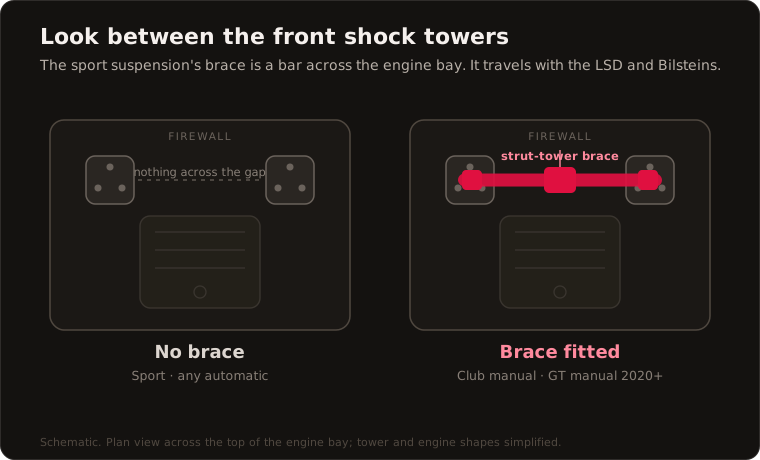
Weight it accordingly when shopping. The LSD is the expensive thing to add later; the dampers are not. If you already plan coilovers, the Bilsteins are parts you’ll remove, and a clean Sport or early GT manual plus an aftermarket diff is rarely cheaper than just buying a Club. The brace and stock Bilsteins matter most if you intend to run the car as delivered, which is also where stock-class autocross rules put you.
Two caveats keep the sport suspension in perspective. First, the factory tune is soft even on the Bilsteins, and the factory alignment is set up for safe understeer by design, aimed at the cruise-oriented buyer rather than the hard driver (r/Miata).
Second, the front brace itself does less than its presence suggests. On the ND’s double-wishbone front end the shock towers don’t carry suspension geometry the way a strut car’s do, so a strut brace is already limited in how much it can improve things here. The brace still earns its keep on this page as a buying tell: it rides only on the cars that also have the LSD and the Bilstein tune.
The Brembo/BBS/Recaro package decides your wheel options
Section titled “The Brembo/BBS/Recaro package decides your wheel options”The Club’s one big option bundles Brembo four-piston front calipers, forged 17-inch BBS wheels, aero sill extensions, and, from 2018, heated Recaro buckets. It opened at $3,400 in 2016–2017 for the Brembo/BBS/aero content, jumped to $4,470 in 2018 when the Recaros were added, and has climbed to $4,800 for 2024 and $4,900 for 2025. The history in one line each:
- 2016–2017: Brembo/BBS package, no Recaros.
- 2018–2019: Recaro seats added; RF cars could order it from 2019.
- 2020+: Recaro version is the only package offered.
- 2022+: standard equipment on every RF Club.
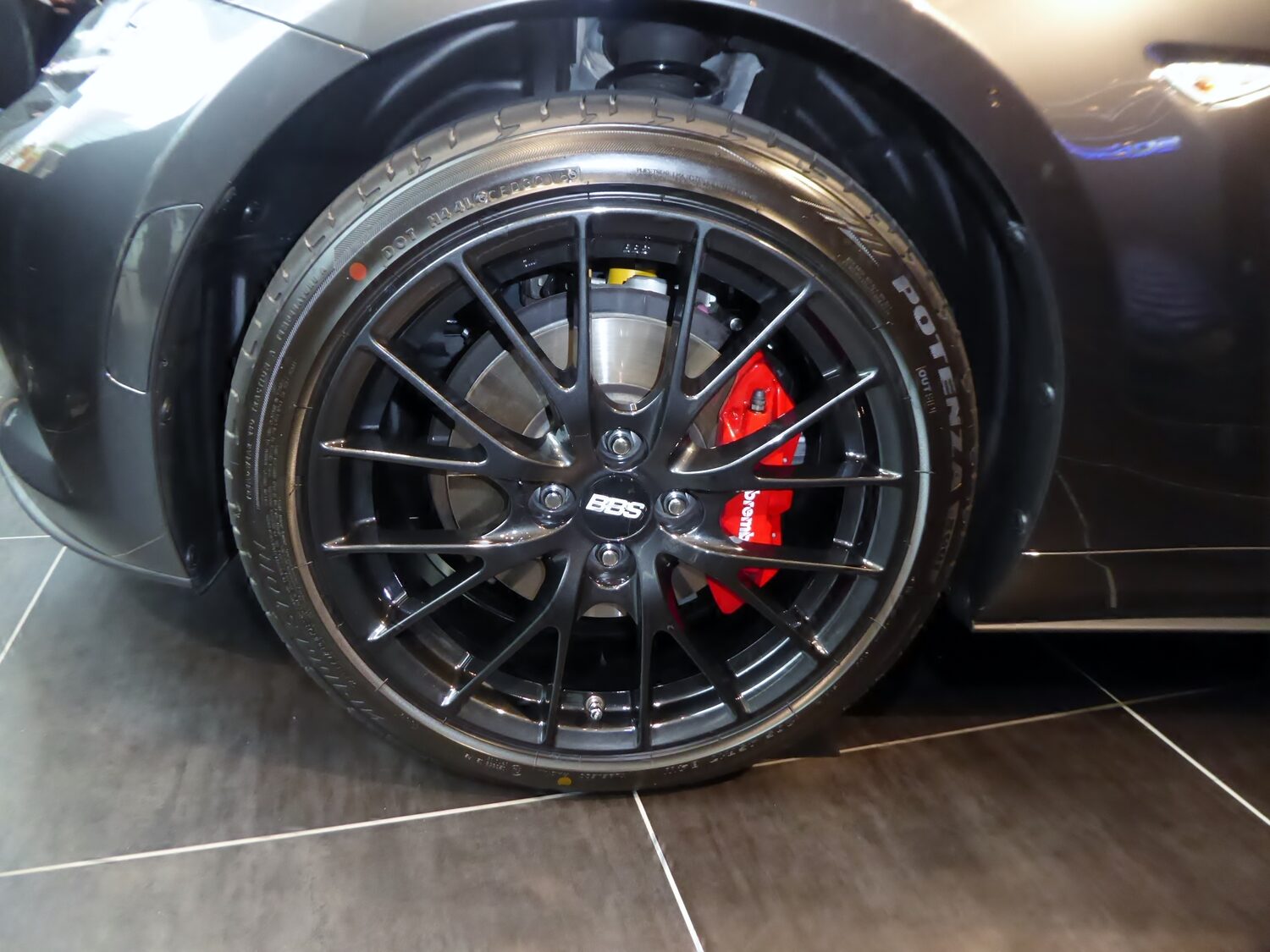 BBS forged 17-inch + red Brembo
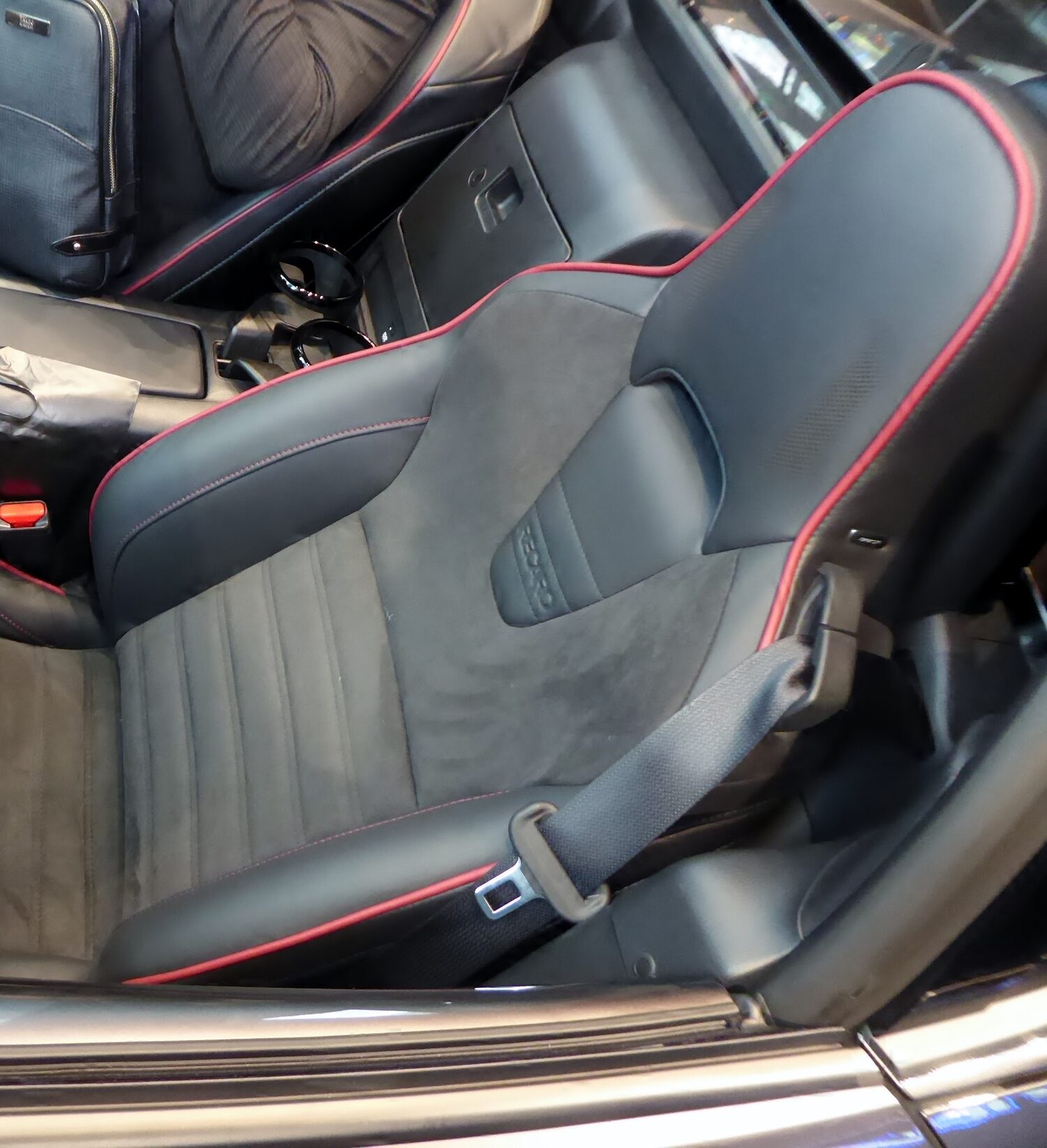 Recaro bucket
The brakes are the part that follows you around. The Brembo fronts tighten wheel clearance: most 17-inch aftermarket fitments need a small spacer (on the order of 8 mm) to clear the caliper, and 16s get harder still. Note that the popular 15-inch autocross sizes are off the table on any US ND with stock brakes, Brembo or not; the standard 2.0L front calipers already don’t clear 15s. The details and the workarounds live on lightweight wheels and wheel and tire fitment.
For value, treat the package as mostly a seat upgrade. Owners broadly rate the brakes and wheels as minor: the stock brakes are fine for the street, and a track build does better with aftermarket pads or a big-brake kit anyway. That puts the decision on the Recaros: with the Brembos and BBS wheels rated as minor, owners often conclude that paying $4,000–$5,000 extra essentially for the seats isn’t worth it (r/Miata).
The Recaros are the one item you cannot cheaply replicate later, since they are expensive to retrofit, and they split opinion by torso: more lateral hold than the standard seats, with bolsters and a fixed shape that fit some drivers badly. Fans describe the base seats as near-supportless next to the firmer Recaros. The consistent advice is to try a set before paying the premium for a used car that has them, because plenty of owners sit in them and still prefer the standard seats.
The package adds nothing to power or suspension; a non-package Club with good pads is the value pick for track use (see brakes before assuming you need the Brembos at all).
Bose is the tell for the comfort equipment
Section titled “Bose is the tell for the comfort equipment”Club and Grand Touring carry a nine-speaker Bose system with speakers in the headrests; Sport does not. It matters twice: top-down phone calls and music genuinely work better with headrest speakers, and the visible grilles are a five-second trim check when a listing claims “Club” on a car that looks base. Grand Touring stacks leather, heated seats, navigation, adaptive headlights, and (by year) driver-assist extras on top. None of it changes the chassis; all of it shows up in the price.
Special editions are paint and trim on the same hardware
Section titled “Special editions are paint and trim on the same hardware”- 30th Anniversary (2019): 643 US cars of a 3,000-unit worldwide run. Racing Orange, forged RAYS wheels patterned on the Global MX-5 Cup car, orange-caliper Brembo fronts with Nissin rears, Recaros. Mechanically a 2019 ND2; you pay a collector premium for the color and the number plaque.
- 100th Anniversary (2021): GT-based, Snowflake White Pearl over a red leather interior and red soft top (black roof on RF). Manual or automatic, so apply the LSD table.
- 35th Anniversary (2025): 350 US cars, Artisan Red over tan Nappa leather, soft top and manual only, GT-based at $36,250. Manual GT means it carries the asymmetric LSD and Bilsteins.
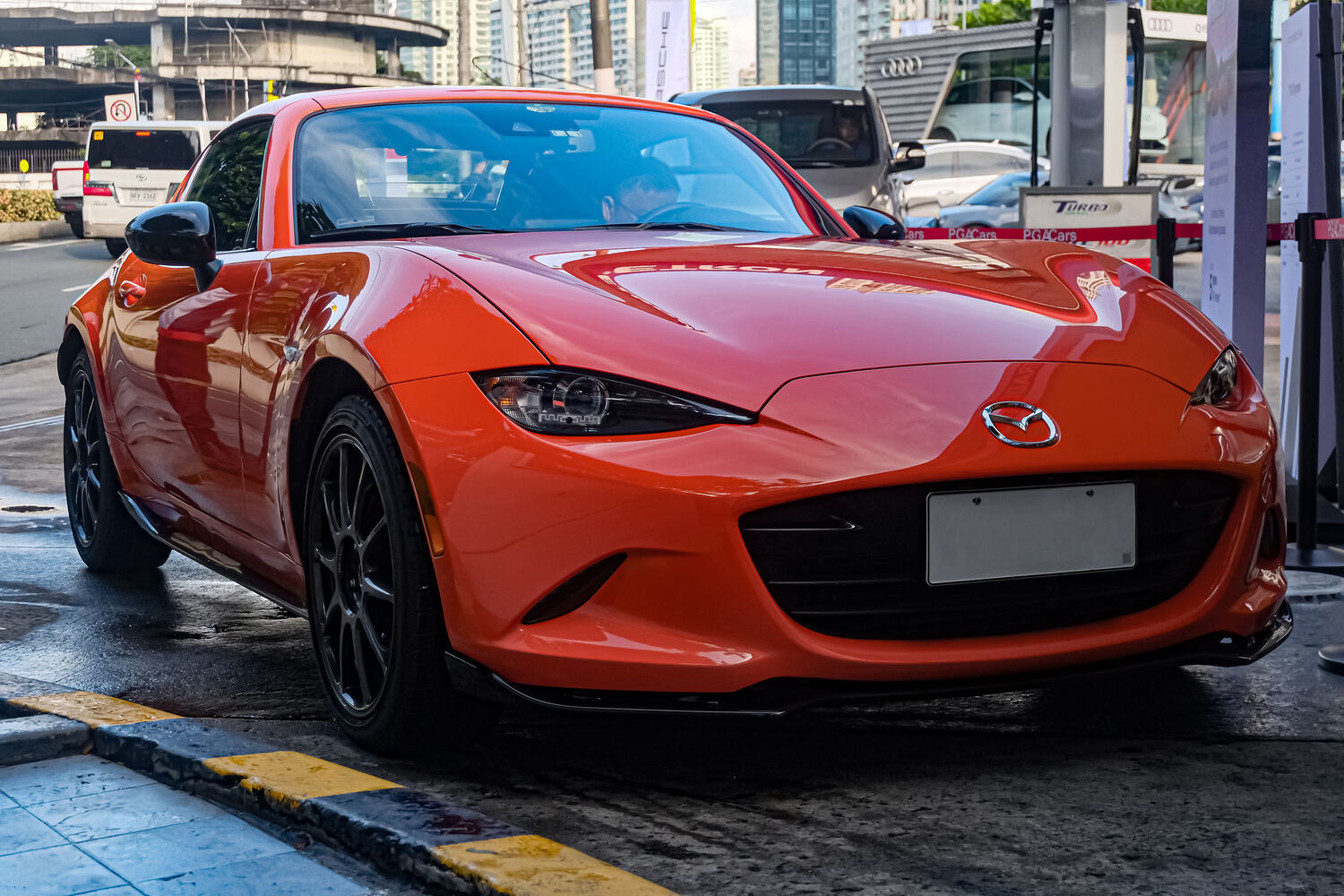
Buy a special edition for the spec, not the hardware: each one’s mechanical content is readable straight off its base trim and year.
What the trims cost new, and what holds value used
Section titled “What the trims cost new, and what holds value used”Trim is mostly a pricing ladder, and the gaps have held steady across the run: the Club lists about $3,500 over the Sport, the Grand Touring about $1,800 over the Club, and the Brembo/BBS/Recaro package adds $4,500–$4,900 on top of a Club. Soft-top manual MSRPs, before destination:
| Year | Sport | Club | Grand Touring |
|---|---|---|---|
| 2022 | $27,300 | $30,800 | $32,300 |
| 2024 | $28,985 | $32,485 | $34,285 |
| 2025 | $29,530 | $33,030 | $34,830 |
Sources: Mazda’s 2022, 2024, and 2025 pricing releases. The 2016 launch Sport opened at $24,915. The RF hardtop runs higher across the board: a 2024 Club RF listed at $40,210 against the soft-top Club’s $32,485.
Used, those numbers compress hard. CarGurus puts the broad ND used range at $16,900–$33,300 with no clean split by trim, because Mazda never published production numbers per trim. What the data does show is that the Club’s hardware largely keeps its value: in KBB’s five-year look at the 2020 cars, Sport, Club, GT, and RF resold within about $1,300 of each other even though the Club cost roughly $3,700 more than the Sport new (Jalopnik, citing KBB). You recover most of the LSD-and-Bilstein content, but there is no clean published “Club premium” to quote, so treat it as directional rather than a number.
One reality for cross-shoppers: the fully loaded Club is genuinely scarce, which is the practical case for widening your search radius. Owners report the Club was only about 20% of the US market, most without the BBS/Brembo package, and a Club that also has the Recaros is rarer still: one buyer found just 2 fully-loaded Clubs among 40 ND2s for sale (r/Miata).
Resale overall is strong but not class-leading: iSeeCars pegs the MX-5 at about 69% value retention over five years, behind the GR86 and BRZ in the same segment. The Miata holds its money well; it is not the single best-retaining sports car, despite the reputation.
How trim constrains classing, tires, and mods
Section titled “How trim constrains classing, tires, and mods”For stock-class autocross, trim is the one mod you’re allowed. SCCA Street rules won’t let you add a diff or change spring rates, so a Club (or 2020+ GT manual) starts with the LSD and suspension a Sport can never legally gain. The full argument is on autocross classing; if you’re new to the sport, start with your first autocross.
The Sport’s 16s are the budget tire play. A 195/50R16 in a 200-treadwear compound runs meaningfully cheaper than the 205/45R17, and the extra sidewall is more forgiving on the street; some owners deliberately step ND2s down to 16-inch wheels for extra pothole and bump protection (r/Miata). The flip side: the 17-inch cars have the wider stock footprint, and the Brembo package narrows your aftermarket wheel choices (previous section).
For a build, trim matters less the deeper you go. Coilovers replace the Bilsteins, big pads or kits replace the Brembos, but nothing cheap replaces the LSD. That is why the used-market premium for a Club manual holds. If the car is headed for track days, the track hub lays out the order of operations.
Verifying a used car: trust the hardware, not the listing
Section titled “Verifying a used car: trust the hardware, not the listing”Listings mislabel trims constantly, and a “Club” badge says nothing about the transmission-dependent hardware. A factory automatic Club, for example, has no LSD, no Bilsteins, and no brace; those were always manual-only. Five checks, no tools except a jack for the last one:
- Headrest speaker grilles. Present on Club/GT, absent on Sport.
- Under the hood. The front shock-tower brace is a visible bar between the strut towers (see the schematic above). No brace on a manual “Club” means the car is not what the ad says.
- Dampers. Bilstein bodies are yellow and readable through the front wheel spokes with the wheel turned.
- Brakes and wheels. Brembo-branded four-piston front calipers and BBS center caps identify the package. Recaro logos are stitched into the seatbacks.
- The diff itself. With the rear wheels off the ground and the transmission in neutral, spin one rear wheel by hand. Both wheels turning the same direction means a clutch LSD is present and engaging; the opposite wheel spinning backward means an open diff. A worn LSD can behave ambiguously here, so treat a backward-spinning wheel as disqualifying, not a same-direction spin as proof of health.
Paper backs up the hardware: ask a Mazda dealer (or the seller) to pull the factory build sheet by VIN, which lists installed packages, and confirm the original window sticker if one is floating around. Then run the normal used-ND inspection.
Further reading
Section titled “Further reading”- ND buying guide: the full pre-purchase inspection
- Best years to buy: where the 2019 split lands by budget
- ND1 vs ND2 vs ND3: the generation changes underneath the trims
- Cost of ownership: what an ND runs after you buy it
- Autocross classing: why trim is a classing decision
- Lightweight wheels: the 15-inch problem and Brembo clearance in detail